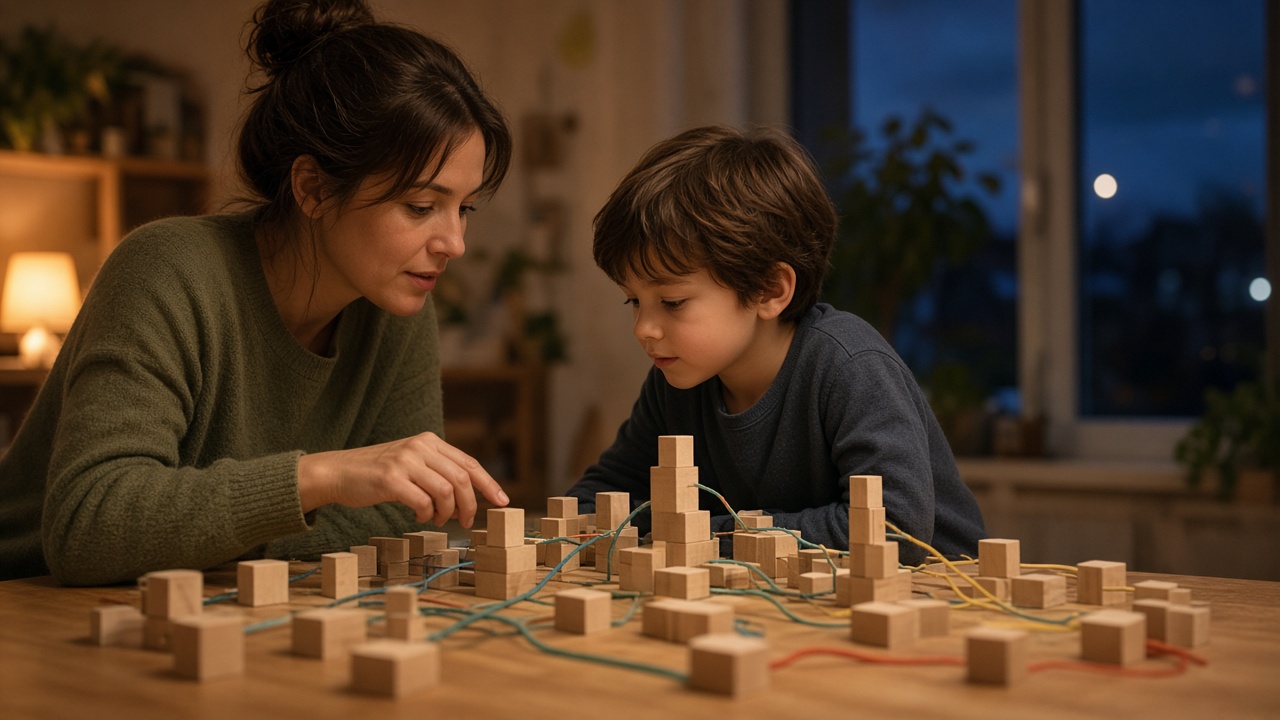
Children already meet artificial intelligence as a voice in a speaker, a homework hint, or a picture that appears after a short request. Those meetings are real, and they are also incomplete. Behind the answer is a chain of computers, networks, electricity, and people who build and pay for the systems. Parents do not need a technical lecture to say that. They need a few true sentences, a refusal of scare stories, and a refusal of slogans that turn the future into a promise of easy money.
This article is parental education. It is not a script for recruiting children into any network, and it is not financial or legal advice. MetaEdge has planned The NEST for 2026 as a contributor network for unused bandwidth. Participation, if it is offered, is for adults aged 18 and over. Children do not install nodes. Rewards would be variable and are not guaranteed. The useful lesson at home is how the economy works, not how to join it just yet.
Start from ordinary life, not from a slogan
A good explanation starts with something the child has already seen. A map that suggests a route, a caption under a photo, or a program that finishes a sentence are all examples. Ask what the tool did, and what it did not do. It did not know the family. It did not walk into the kitchen. It produced an output from patterns and from data that other people had gathered. That is enough for a first conversation. You do not need the word “model” on day one, and you do not need a warning about the end of work.
Slogans get in the way of that picture. “AI will do everything” and “AI is just a trick” are both too blunt for a household. So is any line that says the future belongs to children who start earning from technology now. Children can be curious without being early adopters of a product. Parents can say that some tools are useful, some are wrong, and some are simply not for this house yet. The tone can stay as ordinary as a conversation about crossing a road: look, ask, and let the adult decide.
Fear is a poor teacher here, and so is excitement that skips the facts. If a child is anxious, shrink the subject. Talk about one tool the family actually uses, and about the off switch. If a child is dazzled, shrink it the same way. Name the company or the app, say that it is a business, and say that businesses have costs. You are not required to predict which firms will matter in ten years. You are required not to borrow their advertising as a family lesson.
Show that the economy is physical
The AI economy is a name for the money, work, and equipment around these tools. Servers sit in buildings. Cables and home routers carry traffic. People label data, write software, answer support questions, and pay electricity bills. A child can understand a warehouse easier than a cloud. You might say: the cloud is someone else’s computer, in a building, using power. That sentence does not make the child an engineer. It stops the idea that answers appear from nowhere and therefore cost nothing.
Household technology is part of the same map, at a much smaller scale. The family pays for a connection. Phones and computers are sometimes busy and sometimes quiet. Companies that need to reach public information may, in time, pay to use spare capacity that adults choose to offer. MetaEdge describes that kind of path for The NEST, planned for 2026, with encrypted enterprise traffic that is meant to stay apart from family files. Those are design claims to check later. For now they are a way to say that infrastructure is a choice, not magic.
Keep the later roadmap in its place. Company material also mentions ideas for storage and computing around 2027, and a more distant robotics notion around 2028. They are marked as future concepts and may change. Children do not need that calendar as a set of promises. If they ask what comes next, a fair answer is: adults will read what is actually offered, in this country, when it exists. Until then, the physical lesson is enough. Machines use power. Networks move data. People decide.
Teach consent without making children afraid
Privacy can be taught as a household rule rather than as a threat. Some information is for the family. Some can be shared with a named adult’s permission. A tool does not become trustworthy because it is polite. Parents can show a permission screen and ask, in plain words, what the app is asking to see. If the answer is unclear, the adult closes it. Children can copy that habit of pausing. They should not be told that every new program is dangerous, or that every refusal is a victory.
The same calm applies to a future node. MetaEdge says The NEST is designed so personal files, browsing history, and local storage stay untouched, and so enterprise requests stay encrypted and isolated. Parents can explain the idea of a fence: work for a company would use a path outward, not the drawers in the house. Then add the adult sentence. We will believe the fence when we can read it in the real documentation and see the controls. A child does not need to test the fence. Testing is not a learning activity in this case.
Consent also covers other people’s data and other people’s time. A funny voice clone of a classmate, a photo of a friend dropped into a generator, or a copied essay are not neutral experiments. Parents can say why without a lecture on statutes. We do not use someone’s face, voice, or schoolwork as raw material. We do not hide a tool’s help when a teacher asked for the pupil’s own words. These rules sit beside any talk of an AI economy. An economy that ignores consent is a bad example, even when the software is clever.
Talk about money without a number
Children will ask whether the family can earn from the internet, from a gaming PC, or from “the AI thing at school.” The honest answer is that some adults, in some places, may later receive variable rewards for capacity that a service actually uses. Nobody can say the amount. Demand, location, eligibility, and terms all move. A number from a video is an advertisement or a guess. Parents can say “we don’t know” and stop. Filling the silence with a hopeful figure teaches the wrong lesson about money.
It is also fair to say what the family will not do. We will not buy a new computer so that it might pay for itself. We will not leave a loud machine on at night because of a possible reward. We will not ask a child to install anything, watch a balance, or tell friends that our house is earning. The NEST is planned for 2026 and is not a job for children. If a real offer appears, adults will read it. If the offer is unclear or unsuitable, adults will leave it. That is a complete money lesson.
Older children can hear a little more about costs. Electricity, a worn fan, and a crowded connection are costs even when no cash leaves a wallet that day. A reward that does not cover them is not a win. Younger children do not need this arithmetic. They need to hear that adults handle bills, and that a tool’s fun is separate from the family’s income. Separating those ideas prevents a child from feeling responsible for a result they cannot control, and from boasting about a result that does not exist.
Questions worth answering
Invite questions that build judgment. Who made this tool? Who pays for it if we do not? What happens to the words we type? Can we turn it off? What should we do if a friend says everyone is already making money? These questions are better than a quiz on vocabulary. Parents do not need perfect answers. “Let’s look it up together” is a sound reply when the privacy page is the real source. Inventing a reassurance is worse than a pause.
Some questions should be redirected, kindly. “Can I install it on my phone?” gets a no, with the reason that accounts and software of this kind are for adults. “Can I use the family computer if I don’t tell anyone?” gets a no, because hidden installs break trust. “Will we be poor if we don’t join?” gets a no to the premise. A household’s security does not depend on an unreleased network. Children should leave the conversation more settled, not recruited and not alarmed.
You can end with a family sentence the child is allowed to repeat. Ours might be: AI is a set of tools that use computers and power; our private files stay private unless an adult decides otherwise; and nobody in this house installs a node except an adult, later, if the terms make sense. Children who can say that have learned something sturdy. They do not need a certificate, a referral link, or a role in a product launch. The explanation has done its job when the question can rest.
Keep the doorway adult
Literacy is not participation. A child who understands bandwidth is still not the right person to accept terms, create an account, or leave software running. Eighteen is the floor for participation in this model, not a target for precocious exceptions. A teenager who helps a parent read a screen can still be told that the click belongs to the adult. Helping is not a loophole. If the only person who wants the software is under 18, the household simply waits.
Parents should also watch the social pressure that arrives through friends and short videos. A calm reply is a script, not a debate: we don’t install from forwarded links; we don’t share screenshots of money; we don’t use school devices. Repeat it without mocking the friend. Children are allowed to find technology interesting. They are not asked to defend the family’s pace. The pace can be slow because The NEST is still a 2026 plan, and because the family has not seen final terms.
Return to the same explanation when the news changes. New product names will appear. Some will be useful, some will be noise, and some will aim at parents through their children. The stable points remain. Machines and networks are physical. Consent is a household rule. Money from unused capacity, if it ever exists here, is variable and adult. None of this requires fear, and none of it requires a slogan. It requires a parent who can say both “I don’t know yet” and “not on your device.”
Frequently asked questions
How young can a child be to hear about the AI economy?+
There is no single age. Use examples the child already meets, and stop when the explanation is enough. Younger children need a simple picture of tools, power, and adult rules. Older children can hear about costs and privacy pages. No age is a reason to let a child install software or hold an account.
Should we mention The NEST by name?+
Only if the family is already talking about it. Say that it is planned for 2026, that it is not open everywhere now, and that any future account would be an adult’s. Do not present it as a school project or a way for children to earn. Rewards are not guaranteed.
What if my child is scared of AI?+
Shrink the subject to one tool you use, and show how to close it. Avoid stories about lost jobs or hidden surveillance as the opening lesson. Privacy rules can be calm: family files stay family files unless an adult agrees. Fear is not required for a true explanation.
What if my child wants to earn from our internet?+
Say no to installation and no to a promised amount. Children do not install nodes. Participation is for adults aged 18 and over. Any future reward would be variable and is not guaranteed. This is not financial advice, and a video with a number is not evidence.
Is this a lesson the school should run instead?+
Schools may teach parts of digital literacy. The decision to install software, accept terms, or connect a household node still belongs at home, with adults. Do not put sharing software on a school device. A classroom explanation is not permission to join a network.